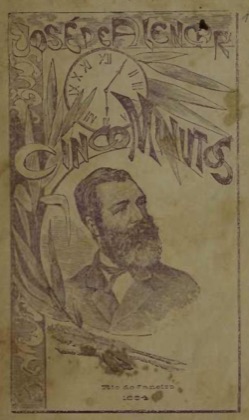
Missing an omnibus by five minutes leads a young man to an encounter with a mysterious woman whose face remains hidden. Captivated by her voice and fleeting presence, he sets out to find her, discovering that their chance meeting conceals a much more difficult story.
A compact narrative helps, but emotional imagery and older spelling add difficulty.
Guiomar, a young woman raised under a wealthy baroness's protection, finds herself courted by three very different men. As affection, family expectations and social ambition pull in competing directions, she considers which future will best suit her own clear-eyed understanding of happiness.
Social irony and indirect intentions require attention to figurative and idiomatic speech.
Gonçalo Ramires hopes a historical novel about his heroic ancestors will win him literary fame and a place in politics. As he writes, his everyday compromises clash with the courage of his fictional heroes, turning a family chronicle into a witty portrait of ambition and national pride.
Social irony and descriptive passages mix colloquial dialogue with historical vocabulary.
Calisto Elói, a provincial gentleman devoted to old books and old virtues, arrives in Lisbon determined to bring moral order to parliament. City life, political ambition and an unexpected attraction gradually test his principles in a comic story about how easily a reformer can be reformed.
Political satire and expressive dialogue require familiarity with social idioms.
A narrator recalls the remarkable Fradique Mendes, a cosmopolitan poet and traveler whose conversation makes a lasting impression on everyone he meets. A fictional memoir and a series of letters reveal his skeptical, often playful views on culture, politics, religion and the habits of Portuguese society.
Literary allusions, figurative description, and older orthography make these letters demanding.
These short stories range from awkward romances and sharply observed social encounters to legends, religious tales and journeys into the fantastic. Whether following a troubled lover or an unexpected act of compassion, Eça de Queirós brings irony and sympathy to questions of desire, belief and human weakness.
Short narratives vary in voice and use descriptive imagery, idioms, and older forms.
Afonso's devotion to Teodora survives separation and her marriage to another man, drawing him into a passion that threatens his peace and future. Against this consuming attachment, the quiet constancy of Mafalda offers another possibility in a story about desire, disappointment and renewal.
Archaic orthography, religious imagery, and elaborate emotional reflection require close attention.
The young hunter Jaguarê seeks a feat that will earn him a warrior's name and a place of honor among his people. Rivalries in love and combat draw him into the affairs of neighboring nations in an idealized adventure set in Brazil before European arrival.
Indigenous terminology, historical commentary, and archaic orthography need contextual reading.
Born amid religious persecution, Brás Luís grows up under the protection of others and sets out to become a physician. His search for belonging unfolds through hidden family ties, love and danger in a Portugal where ancestry can determine a person's freedom and future.
Older spelling, formal narration, and religious terminology require advanced vocabulary.
Carlota Ângela falls in love with a naval officer, while her wealthy parents expect a marriage that will preserve their fortune and status. As they maneuver to separate the couple, her determination brings love into conflict with family authority, deception and religious pressure.
Emotionally direct scenes use idioms, extended clauses, and formal narrative language.
Rosa Guilhermina's father plans to marry her to a wealthy older merchant, but she has wishes and attachments of her own. Her resistance sets off a lively tangle of courtship, money and family intrigue, told with a sharp eye for hypocrisy in church and society.
Archaic spelling and abstract emotional narration add difficulty to the conversational scenes.
A poetry-loving shoemaker gives his son Fernando an education that opens doors beyond the family's modest beginnings. Yet shame about his father's trade, social ambition and the search for love draw Fernando into a world where wealth and rank compete with gratitude and loyalty.
Clear conflicts and letters help, while older spelling and formal narration need support.
Sign in to add this title and keep your place.
Source and license
A level is a starting point.
These are approximate editorial reading guides, not certified CEFR assessments or a test of your proficiency. A classic’s range reflects this edition’s language; a short story’s label is its writing target. Familiarity with the subject and the help you use can change how a text feels.
You can read immediately once a title is in your Library. Translation, vocabulary checks, and chapter preparation are optional. Sign in to add a title and keep your place; account capacity and beta availability apply.